Garden
Is probably impossible, but after losing all the tomatoes in New York, we’re trying to see if at least one of the Maine tomato patches ( 2 outdoors, one under plastic) can pull through and produce.
Organic management tools include:
Fungicide
Fertilizer
Being There
Being Careful
Being Realistic
Being fond of cherry tomatoes
And perhaps most importantly, Being a procrastinator – at least in our case… If I’d done all the tomato grafting I’d planned to do, there wouldn’t have been any leftovers in the greenhouse.

Tomato plants in the greenhouse have so far escaped the blight.
Read More…
are all the wages of a wet summer, but the greatest of these is Late Blight. Our resident mycologist has the scientific perspective – and as he is also our tomato maestro, a very heavy heart. Here is his report on the New York garden, with a full explanation of the disease and how it spreads:
LATE BLIGHT –PHYTOPHTHORA INFESTANS– SWEEPS THROUGH THE NORTHEAST
By Bill Bakaitis
I was in Maine when the word came in: Late Blight was laying waste to tomato fields in the Hudson Valley. Oh, say it ain’t so I pleaded. Leslie and I had been extra cautions this spring in starting from seed, setting out, cultivating, and protecting our tomatoes, fifty or so plants of some twenty or so varieties, mostly open pollinated heirlooms. They were specially grown from selected seed in our own greenhouse and in another in Maine; some heirlooms were painstakingly grafted onto disease resistant rootstock. The spacing was good. The plants were held up by a twine-between-post well-ventilated system, the ground carefully mulched with bright straw over paper, and all the lower branches were removed so as to exclude the transmission of soil borne pathogens. In addition the plants had been treated with Bacillus subtilis (Serenade tm) to protect against fungal infection. Say it ain’t so I prayed as I piled into the car and raced home through a driving rainstorm, thick as I had ever experienced.
But it was so.
Read More…
This started out being about garden volunteers, the children of plants with such willing seed you can count on new generations more or less for the life of the garden. But including everything the list turned out to be so huge it was about 2 books worth – plus a whole gigantic sidetrack about invasives.
So then it was just annuals – flowers and herbs that more or less behave themselves. Then it was annual flowers and herbs that more or less behave themselves in the Northeast.
Then, unable to decide on images, I got it down to larkspur and Shirley poppies. And now, for the sake of brevity:

a volunteer Shirley poppy.
Read More…
If only. As a species of aggravation, Marmota monax, the largest and most pestilential member of the squirrel family is impossible to get rid of. There are a number of reasons we will get into in a moment.
First, however, the good news: you can get rid of one or more individuals, and that can often make the difference between having a harvest and not. Furthermore, you can get rid of them using a live trap, especially if you use one from Williams Trapping Supply.
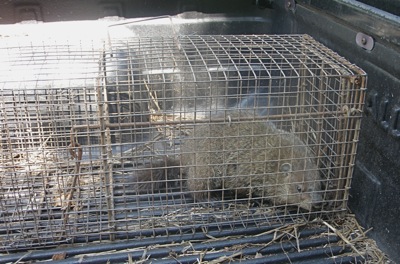
young groundhog in live trap, about to take a trip
Read More…
They’re out, just about right on time.
In spite of the deluginal rains, not too many mushrooms have come up yet, and a recent visit to a favorite spot was not very productive, so we weren’t expecting to come upon them.
Dumb. If you want to collect a lot of mushrooms, always expect them.

Chanterelles in the only container available
As usual, they were hiding – but visible to anyone who was on the alert for a glint of orange
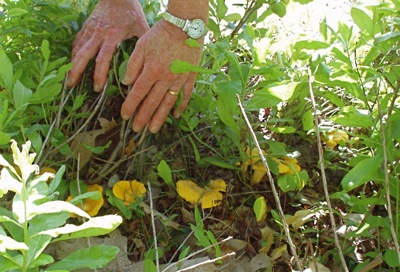
Chanterelles in typical spot
Bill has already written a super guide to chanterelle hunting, so my contribution comes from the kitchen
Read More…
As far as I’m concerned, garlic gets the blue ribbon for growing your own. It’s absurdly easy to plant and care for; it tastes great; it looks beautiful and it takes up so little ground that even those with very small gardens can raise enough to be self-sufficient in garlic for a good part of the year.
All you have to do is choose the right varieties; plant at the right time, in the right soil; then harvest when just right and store correctly.

Home grown garlic, fresh out of the ground
CHOOSING VARIETIES
If you look in a specialist catalog like the one at Gourmet Garlic Gardens, you’ll find dozens of choices. The folks at Filaree Farm, who offer a hundred, divide them into 7 groups: Rocambole, Purple Stripe, Porcelain, Artichoke, Silverskin, Asiatic Turban and Creole. Gourmet GG says it’s 10 groups because they divide Asiatic from Turban and add Marbled Purple Stripe and Glazed Purple Ptripe to the list.
You see where this is going – and you can see a lot more on either of those websites, but for general purposes the most important difference is the one between softneck and hardneck.
Read More…
So far, no summer for us in Maine – and not much in the Hudson Valley, either. But that won’t stop autumn from arriving in about 5 minutes. Time to get the fall bulb list together and I’m not just talking tulips (and daffodils, crocus, muscari, scilla …)
Not by a long shot. After all the spring beauties are done there’s a whole new round of effortless delight, thanks to the alliums. Ornamental types shine in June – especially in weather like this on account of they’re rainproof – and of course there’s garlic: scapes right now, mature bulbs in mid to late July.
Walking through the garden these last days I see I don’t have enough

Allium christophii
Read More…
In Maine, the chilly rain is now bidding fair to be every day for the entire month of June, and it’s not much better in the Hudson Valley. Or not much less rainy, anyway. It IS better there in general because it was warmer longer sooner, giving plants a good head start – and the rain itself is warmer.
I keep telling myself this too shall pass – There’s photographic proof from last July, when Lois was painting in the garden.

There can be so much sun you need an umbrella for that
But it’s difficult for me to listen to me, so I’m glad there are a few things I can do to help avoid total catastrophe.
Read More…
Maybe. At least it’s a plausible explanation from what might be called a reliable source, the scientific journal Evolutionary Ecology.
Here’s the summary, with illustration and caption, from the BBC (photographer uncredited, unfortunately):
The Plant That Pretends to Be Ill

A leaf damaged by mining moths (left) compared to one faking it (right).
Short version is they do it to look sick, thus fooling the bugs that might make them sick into thinking they’ve already been drained of vitality.
Words cannot express my investment in this explanation, but if YOU have been expensively seduced (over and over) by some gorgeous variegated thing, only to find when you got it home and put it in the garden that it just looked sick, you will know what I mean.
Not much, unfortunately, when you have downpours like the ones that the Hudson Valley’s been having for the last two weeks. I don’t suppose it makes sense to call anything this soggy ” toast,” but our peonies are over for this year.
They did ok though the first couple of storms, so there were still plenty to pick when I got here from Maine

Cache-pots aren't just for pots. Use a glass or china liner in metal ones (to extend the vase life of the flowers).
At that point, the peony hedge looked like this

Not great, standupwise, but not bad - except for that white one at center right
Read More…