Garden
Did you keep cutting off the rhubarb flower buds, doing your best to extend the season by preventing

Rhubarb flowering instead of making pie material
If so, welcome to the club of “if only.”
Just about every rhubarb grower I know is convinced that removing the flower stalks will
a) keep the edible leaf stalks from growing tough and
b) encourage the plant to produce more of them,
and they are abetted in this belief by most of the published information on rhubarb growing, including that from reliable sources like universities and extension services.
Nevertheless, (a) is untrue and (b) applies mostly to the following season.
Read More…
It can be hard to tell. The squash and bean beetles are orange with black spots and so in many cases are the ladybugs, aka lady beetles.
Two clues:
1. The vegetable eaters are mostly on the vegetables they eat.
2. Most of the common ladybugs have black heads; the pests don’t.
Japanese, squash and bean varieties notwithstanding, beetles in the garden can be a very good thing. Here we see a lady beetle ( probably the Asian one, Harmonia axyridis, although I wouldn’t swear), working on the aphids in the trap crop lambs quarter.

When young, lambs quarter is one of the most delicious greens any garden can grow. As it ages and toughens, swarms of aphids come to infest it instead of your fava beans. Very convenient.

Less good of the beetle, better of the aphids. Never eat anything bigger than your head.
If you don’t count

old faithful Jens Munk,
blooming away at the edge of the woods, the first rose to show its face in the lower gardens was a white hybrid tea whose name I no longer remember. Not an especially pretty plant ( as usual with hybrid teas) but a very pretty rose.
Also a nicely fragrant one. Put your nose in the vicinity and be rewarded with a delightful lemony perfume.
“ Those people who are always on about scentless modern roses have gotten a bit carried away,” thought I , keeping the trophy close to my schnoz as I headed up to the house.
Passed the gone-to-wild-we-still-haven’t-upgraded-it side garden and there was a survivor, the antique gallica ‘Tuscany’, small, semi-double, deep, deep purplevelvet red.
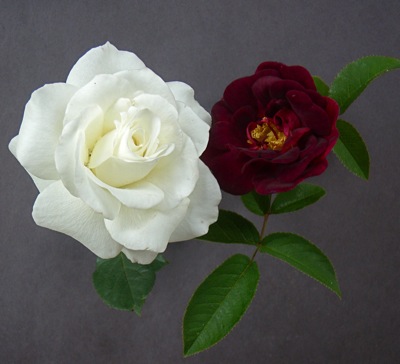
Modern white, antique red
Read More…
Ok, let’s start by being honest. Lilac bouquets do not last, period. Or at least they don’t last like tulips, say, or peonies, or even roses. This is partly because lilacs wilt fast and partly because there’s no wiggle room: tulips and peonies and roses remain beguiling in decline; lilacs look awful as soon as they don’t look wonderful.

To keep them looking wonderful for as long as possible:
* Choose trusses that are about half open – if they’re mostly buds, they’ll just give up before going any farther and if every florette is blooming the end is already near.
* Cut them early in the morning before the bark heats up and put them up to their necks in the large bucket of tepid water you have right with you.
Read More…
What’s to say? A mom and three very playful kits. Beyond adorable – and they don’t eat vegetables.
In fact they eat grasshoppers, voles, mice and similar garden comestibles to which they are more than welcome.
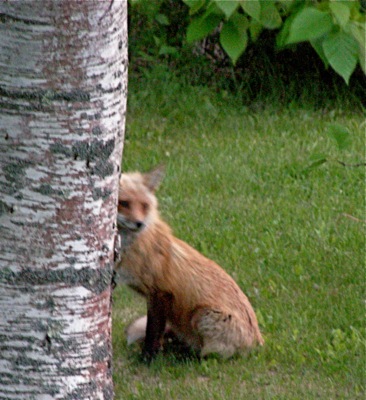
Momfox, somewhat fuzzily through the back window at dusk. Stay tuned for the little ones if I can swing it. They must live in the neighborhood; this is the fourth sighting.
Today we have a question from Leigh Ann:
“My husband gave me a pot of tulips for Mother’s Day, “ she wrote,” how can I save the bulbs to plant next fall? “
Over my years at the Times, most questioners just wanted to know how to get the damn things to come back in the garden, but as the answers are similar and Leigh Ann was first this spring, potted tulips will be addressed in

Parrot tulip Estella Rijnveld, in Maine, in its 6th or 7th year
How to Make Your Tulips Rebloom
Read More…
Figfip? That would be Food Gardeners’ Fine Points, a new occasional series inspired by my friends Matt and Shannon.
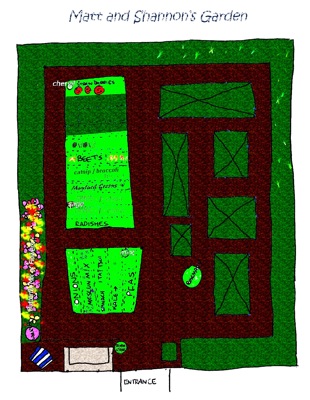
Shannon’s drawing of the garden from when Matt first wrote to say
“ We have some very exciting news. After nearly three years on the waiting list, Shannon and I now have a plot in the community garden next to our apartment building!!!…. Naturally, I have mile-long list of vegetables I’d like to grow….”
He meant it; it is a mile long, ending with: “ Are there any realistic choices for two newbies from that list? We’re prepared for failures and setbacks. But we’re also giddy with enthusiasm. ”
Who could resist an appeal like that?
M&S may be newbies but they’re certainly not dummies ( a title from Hell, imho). They already the have usual gardening manuals and an unusually large ability to conduct web searches. They even have a resident sage at the community garden.
But a lot of “how to” leaves out choice tidbits. Some information does get dated. And I don’t always agree with the sage, even though he’s right with them in Washington, DC and I am in New England.
So from now on, when I’m doing something in the garden and it makes me think “I ought to tell Matt and Shannon about this,” I will. And as I have just been planting vegetable seeds, that’s where we’re going to start.
Read More…
In a lot of ways it’s no different from growing some of the easier vegetables: plant in a good place. Wait, being patient and hoping for rain. Harvest crop.
But of course there are a few fine points, elucidated here in a guest post by our resident mushroom expert.
Growing Mushrooms in Your Garden
By Bill Bakaitis
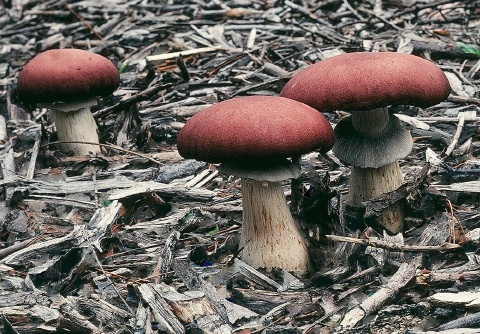
Consider planting Stropharia rugusoannulata in your garden this spring.
If you like to eat mushrooms, and would like to gather them fresh, along with your vegetables, now is the time to consider inoculating a piece of your garden. You can easily fit a patch on one of your paths or tuck it into a mulched weed barrier. Here is how.
Read More…
and a couple – well ok, three – new clematis from Brushwood Nursery are this year’s proof that no matter how much I grouse about the proportion of antiques to rare plants at Trade Secrets, it’s still all too easy to find things you didn’t know you needed until you were standing there needing them.
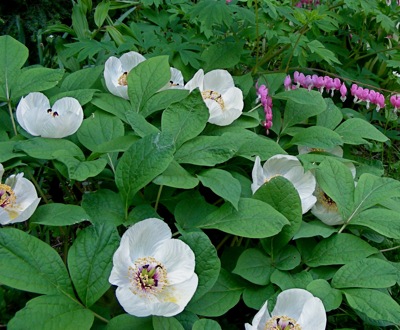
Paeonia japonica ( which will hide the empty bleeding heart space, come midsummer.)
I blame it all on this woodland peony from Hillside Nursery. When I bought it four years ago it was nothing but a robust little popkin with about 3 leaves. Each spring it comes up larger and larger, more and more glorious, (in)conveniently blooming abundantly right before T.S., the only retail show Hillside attends.
Read More…