Garden
Actually pretty gray right now, so that title may be premature, but assuming no more major rains fall (and that you don’t count the new leak in the roof), we got off lightly.
We had buckets out, not rain gauges, so the closest I can put rainfall is 6 to 8 inches; and although the winds were theatrical at 5AM, I doubt they were much over 30mph.

The good part is that it puts the top beans within reach.

You may be looking at this and thinking “What’s the big deal? jar o’ water under a tree.” The big deal is that there’s a huge hole near the bottom of the jar, on the side that’s jammed up against the trunk.
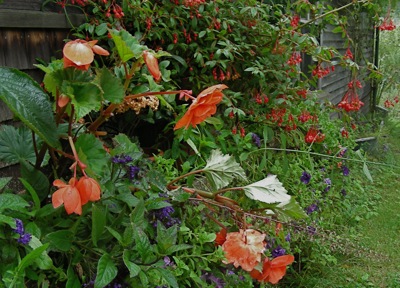
My punishment for not staking up the big begonia. ( The small flowered one hangs anyway)
The impending sweep of storms is likely to fix it, but for right now the Maine garden is still way too dry to start moving shrubbery around. And let us not speak of the bulb order, which as usual (sigh) isn’t done yet. But none of this means next year is being neglected; the easiest fall planting of all is happening right now, all over the garden.
Flowering plants make seeds; it’s more or less their mission in life, so this is the season when negligence rules. No more deadheading! The birds are grateful right away, as anyone knows who’s watched their cosmos bending under the weight of goldfinches. And I’m (almost) always grateful in spring, when there’s a nursery’s worth of volunteers to play with
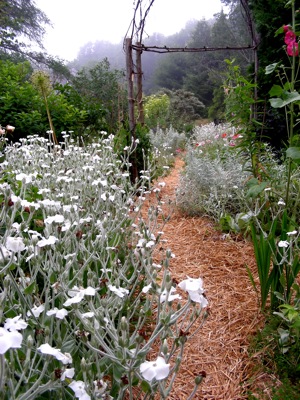
This border of Lychnis coronaria 'Alba' comes back every year, but it was unusually lush this summer because of the drought (hates wet feet).

The peony is Florence Nichols, the background of lychnis buds is the kind of happy accident you get when you let loose the self-sowers.
Read More…

people waiting for something besides food, please be patient. I’ll be with you in a minute, but right now
It’s Tomato Time!
although only because we have two gardens. The plants in Maine are pathetic – it was just too cold, too dry for too long when they were young. But the tomatoes in New York. Omigosh.

Bill ( 5’ 9 or so) in the tomato patch. Note the naked bases, disease-prevention at work.
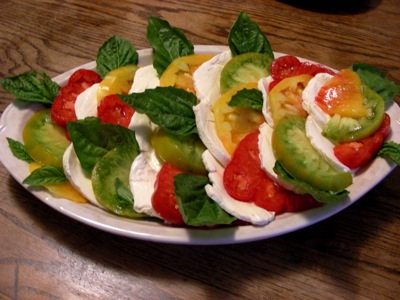
heirloom tomatoes and mozzarella, with lettuce leaf basil
The summer classic, with Pruden’s Purple (red), Malakhitovaya Shkatulla (green), and Hillbilly Potato Leaf (yellow with red streaks)
They’re all different sizes, as usual, but a larger number than usual are larger than usual
Read More…
As the recipes – more to come! – suggest, my job is to have a great time collecting, followed by having a great time cooking and preserving. HIS job is to know where and how to look, so here’s another guest post from mushroom expert Bill Bakaitis.
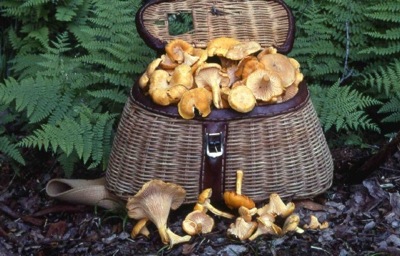
Finding Chanterelles
by Bill Bakaitis
Mention ‘summer mushrooms’ around here and someone is sure to say “Oh yes, Chanterelles! They are the only mushroom I collect.”
And for good reason. They are delicious, they resist insect damage, clean up easily, are distinctive and easy to identify, and are found in beautiful locations. Oh, did I mention that they are delicious?
 Read More…
Aren’t always two flowers, especially in August in Maine, when the sky is cooperating and azure to the max.

This plant is a solo pearl, the only absolutely-no-pink-in-it pure white we’ve ever drawn in the self sown hollyhock lottery. Our winnings are usually dark purple, pink, peach, apricot and primrose, a genetic salad all descended from one packet of yellow fig leaf hollyhocks (Alcea ficifolia) I planted years ago in the (vain) hope they wouldn’t get rust.
Today’s other beautiful white on blue may be more of a special taste Read More…
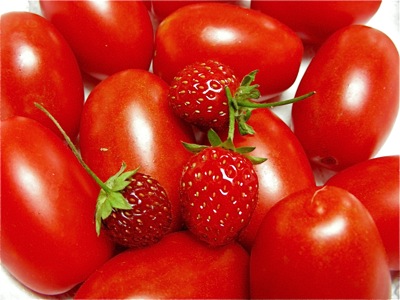
Department of fruit being red so animals will eat it and spread the seeds and Leslie will notice it and take a picture.
This arrangement is not a put up job, honor bright. I came in with only a few strawberries – more on the elusive Mara des Bois shortly – so I just threw them in the basket on the kitchen table on top of the Juliet plum tomatoes, our favorites for drying.
More on that, too, before long, but right now I have to go make supper: chantarelle and lobster-mushroom chowder with la ratte potatoes and what’s left of the grilled sea bass we had last night.
The first seriously beautiful allium that I remember seeing wasn’t an “ornamental” at all. It was a plain old leek that wintered over, didn’t get harvested and burst forth in early summer with a fist sized globe of little white stars, on a naked 3 foot stem. Quite a step up, in more ways than one, from the purple powderpuff flowers of chives. I was immediately hooked.
First and still a favorite: the Star of Persia, Allium christophii, a 2 to 3 footer topped with a loose ball of silvery purple from 4 to 6 inches across
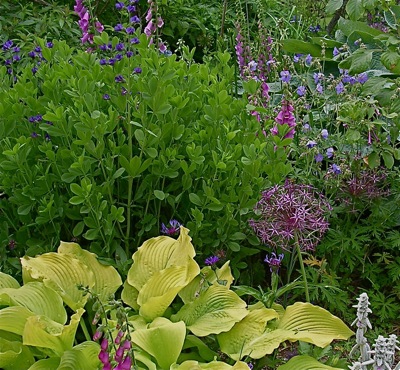
the Star is in the lower right Read More…

aka Chenopodium album, tender, nutlike, easy to cook — and of course very easy to grow. All you need to do is stop pulling it up and start harvesting the tender stems and leaves to sauté in olive oil with garlic, steam in lemony chicken stock, cream just like creamed spinach or make killer lambsquarter quesadillas.

Read More…
Think of Chet Baker in a mellow mood on a summer night, the music drifting in your direction against a background of insects chirping and the sometmes rumble of trucks on the highway and you’ll get a faint approximation of what it’s like to be in our Hudson Valley house when the trumpet lilies are blooming.
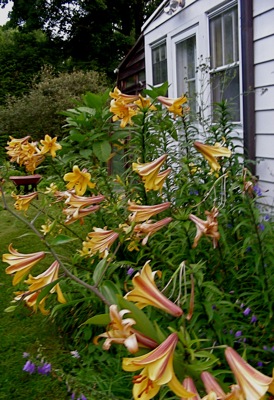
Their heavy, classic lily fragrance has a distinct undernote of spice, and while a bouquet’s worth of it indoors would be so intoxicating you’d have a hangover in the morning, having it waft in from the bed under the dining room window is just about perfect.
So much pleasure from so little work!
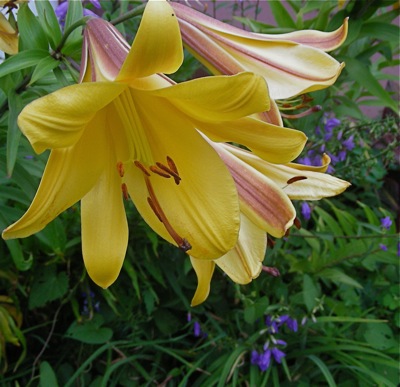
Close up, you can see why they’re called ‘Golden Splendor’. Good As Gold would be appropriate too; this cultivar is one of the most vigorous.
Read More…
The peas are something I’ve taken for granted for a long time now, because classic Sugar Snaps never seem to fail. Good years and bad, those tall, late-bearing vines always come through with about 6 weeks of perfect snap peas: crisp, juicy and sweet. And twenty feet of double row pretty much guarantees enough. In good years, we give a lot away, and even in poor years like this one we still have plenty.  How much is plenty? I never measured before, but we just had an opportunity to check it out – Read More…