in the wild
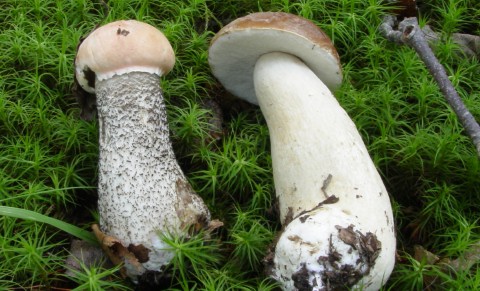
The potentially toxic Leccinum atrostipitatum (left) alongside the Edible Boletus edulis (right).
One of the nifty things about mycology (the study of mushrooms) is that the field is still largely unexplored, new finds and findings turn up all the time. This is a less-nifty thing about mycophagy (the eating of mushrooms, particularly wild mushrooms). It too is still largely unexplored, and new information about bad reactions turns up — not all the time, but frequently enough. Here’s the latest from our resident mushroom expert.
LECCINUM ALERT
by Bill Bakaitis
On July 14th, I received a call from New England Poison Control Center at Maine Medical center. An elderly man was in a New Hampshire Hospital with a severe, life threatening, illness contracted after eating Mushrooms. No specimens were available for imaging, but there were only two mushrooms involved, both Boletes. One was described as a ‘King Mushroom’, possibly in the Boletus edulis complex. The other was probably a Leccinum. Both identities were initially determined by two of the mushroom eaters, all of whom were self described as “good, knowledgeable mushroom collectors”
Two of the three people who collected and ate the mushroom developed GI symptoms three to five hours after the meal. One of them, an adult woman, sought treatment at the emergency room for her distress that evening. The elderly man, developed GI symptoms somewhat later, did not go to the hospital and felt a general malaise the next day. The third person, an adult man, had no symptoms at all.
Three days after the meal the older man was admitted to the hospital in poor condition.
Read More…
If only. As a species of aggravation, Marmota monax, the largest and most pestilential member of the squirrel family is impossible to get rid of. There are a number of reasons we will get into in a moment.
First, however, the good news: you can get rid of one or more individuals, and that can often make the difference between having a harvest and not. Furthermore, you can get rid of them using a live trap, especially if you use one from Williams Trapping Supply.
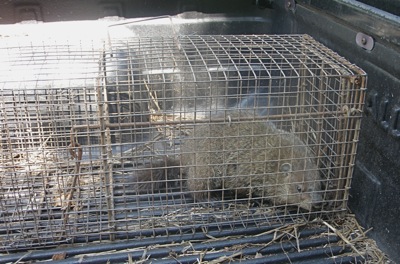
young groundhog in live trap, about to take a trip
Read More…
They’re out, just about right on time.
In spite of the deluginal rains, not too many mushrooms have come up yet, and a recent visit to a favorite spot was not very productive, so we weren’t expecting to come upon them.
Dumb. If you want to collect a lot of mushrooms, always expect them.

Chanterelles in the only container available
As usual, they were hiding – but visible to anyone who was on the alert for a glint of orange
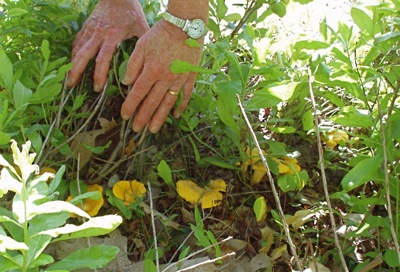
Chanterelles in typical spot
Bill has already written a super guide to chanterelle hunting, so my contribution comes from the kitchen
Read More…

more soon, I promise.
posts upcoming on garlic, garden volunteers , food gardening fine points, chocolate cake — and the Joy of Wrens.
photo by Bill Bakaitis
What’s to say? A mom and three very playful kits. Beyond adorable – and they don’t eat vegetables.
In fact they eat grasshoppers, voles, mice and similar garden comestibles to which they are more than welcome.
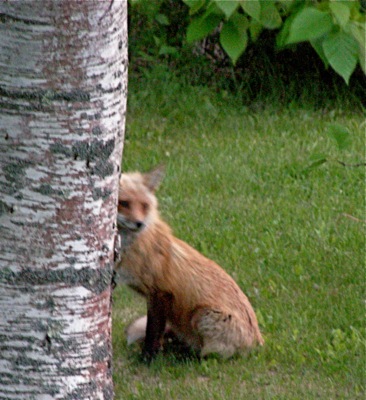
Momfox, somewhat fuzzily through the back window at dusk. Stay tuned for the little ones if I can swing it. They must live in the neighborhood; this is the fourth sighting.
While I’m in Maine getting the summer garden underway, husband Bill, aka Mr. Mushroom ( see his most recent morel hunting tips here) has been holding down the Hudson Valley end: feeding cats, cutting vast quantities of asparagus, mulching peonies, tending the bees , collecting morels – and being inspired by your responses to send another guest post:
Bears, Bees, Bacon and Morels
by Bill Bakaitis
Flash! My neighbor just informed me that the bears are back.
A few days ago he went out in early morning to feed his horse and discovered that the large bin which stored the sweet feed and biscuit treats was missing. Well, not quite missing as there were drag marks and when followed led to one of the neighborhood bears (last year there were five) having an early morning snack of the biscuits. After a brief encounter and short stand-off the bear beat a retreat.
End of that story, but Whoops, thought I, I sure better check the electric fence around our bees and rebait the hot wires with the Rancid Bacon Bear Bait stored in the freezer for just such occasions.

A spreading patch of bloodroot is now encroaching into our small fenced-in bee yard, and over the past few rainy days had grown tall enough to be in contact with the lowest hot wire of the electric fence.
The errant bloodroot leaves sizzled, snapped, crackled, popped and were draining the voltage of the wire. Good timing, I thought and went to the shed for a small sickle, to the freezer for the bear bait, and after disconnecting the solar charger trimmed all of the bloodroot and other vegetation under the fence. That’s when I found the morels. Read More…
As we were spooning in the eggs with asparagus and black morels I was just going on about yesterday, Bill mentioned that he should maybe say something about how to find the blacks – they’re a bit trickier than the main season blondes, but they have a special savor for being the first.
“Have at it! ” said I; and so here is some more from our resident guide to wild mushrooms:
THE FIRST MORELS OF THE SEASON
By Bill Bakaitis
The first morels of the season are the hardest to find. They are not Morchella esculenta, the blonde varieties standing tall under elm and apple but the Eastern Black Morel, M. elata/angusticeps/conica complex.
These early morels usually will begin to fruit near the end of April in the Mid Hudson area, just as the forsythia blossoms fall to earth, the maples begin to leaf out and the black flies begin to bite. I found my first of this season on Saturday, April 25, as the spreading heat wave pushed the thermometer to the record breaking 89 degree mark.

The Eastern Black Morel, typically the first morel of the season
Read More…
Also old-faithful walking onions, always the first to appear, and a handful of garlic chives, currently taking over the side bed that’s due for renewal and therefore has not been weeded at all.

Here in our part of the Hudson Valley, this year spring is on toast in more ways than one. I’m in the office with, I confess, the air conditioner on because none of the shade trees are leafed out yet and it’s 89 **!!@^%! Degrees. Same as yesterday and tomorrow and then on Tuesday it’s supposed to get hot.

The red tulips had one day! Truth. Buds cracked in the evening at bedtime on Friday, full open by noon Saturday, then exhausted by eveniing, just like the rest of us. The pink ones, admittedly, had been open for 2 days but I was rather enjoying them.
So. Looking at the forecast made this morning a nightmarish recap of fall, when you rush around picking all the flowers that will be blasted by frost. Read More…
It was lunchtime. I was in the kitchen. Bill went out to empty the compost before making his umptigazillionth ham sandwich ( This is not a man who believes in varying the midday menu.)
“Hey Leslie, come see what’s in the trap!”
A muskrat.

Full grown muskrat - they're smaller than you'd think.
Read More…

Start on the endless spring to-do list. Lawn and garden cleanup, shrub pruning, seed-starting, seed planting…
and (among yet other things)
* Consider the freezer
* Start on the bulb maps
* Figure out where the garlic is going to go
* Cut back and repot tired houseplants
* Scout for morel spots Read More…