in the wild
Never thought to record sightings, so cannot absolutely swear, but I’m pretty sure there are more and more ‘possums in the mid Hudson Valley, and I’m convinced it’s Zone Creep, wild animal division. The opossum (Didelphis virginiana) has always had a wide range and can occasionally be found as far north as Canada, but the place you find most of them is the South, so if they are becoming common here…
Opossums are nocturnal except when extremely hungry, so most of the ones you see are the ones that have had encounters with cars. But we’ve surprised them many times on evening trips to the compost. And last week right around teatime there was a good sized one in the bee yard, hoovering up the dead bees that get deposited in front of the hives when it’s warm enough for the survivors to clean house.

Opossum eating cake instead of bees (Bill threw some so it would hold still)
This daylight encounter prompted a bit of research. Turns out opossums have a LOT of fans ( who knew?). Read More…
and a whole lot more are over at the PBS website, where you can see the nifty Nature program Is That Skunk?. We saw it the other night, more or less by accident. All my anecdotal observations confirmed; they’re extremely reluctant to spray ( An Eek of The Week that isn’t). And wait’ll you see the spotted ones – some cute!
greeted us when we woke this morning —
no mistaking ’em; skunks’ short legs and long bushy tail create a unique undulating line, stuttering in light snow, smooth as a Japanese brushstroke in deep powder, either way a perfect shadow of their endearing waddle.

skunk tracks in thin snow
I know, I know, a lot of people don’t like them – especially people with dogs. But the problem there is simply that too many dogs don’t know how to back down. Unless you’re threatening the babies or cutting off the line of retreat or otherwise driving the poor thing into a defensive corner a skunk is the most peaceable of creatures. Read More…
No heating season complete without a startup drama, in this case a very loud eek! coming from the woodstove. Bill rescued the source and sent a picture, along with an explanation of why the thing doesn’t look quite right.
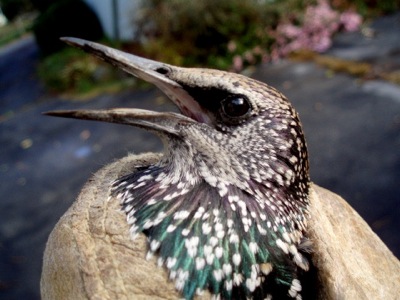
immature starling, bound for freedom
“The starling that came down the stovepipe. By spring the white tips on the feathers wear off and the stronger dark fibers (with melanin) give the metallic coloration.”
It may be bundle up time ( we’ve had temps in the mid-20’s on several nights at this point) but there are still delicious wild mushrooms to be found. Here’s the latest from our resident expert.
THE MUSHROOMS OF AUTUMN
After The Leaf fall
story and photos by Bill Bakaitis
As the days shorten the trees shed their leaves, openings begin to appear in the canopy, and more light penetrates to the understory. Mild frosts will have singed the outer tips of the garden plants and the edges of the forest, but mushrooms such as Honeys can still be found poking through the thin cover of leaves under the thickest forest canopies.
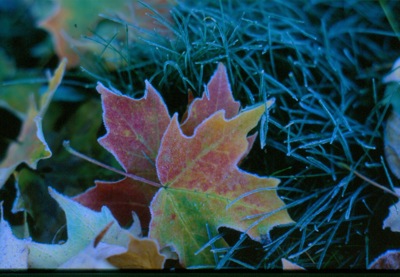
Light frost on Maple Leaves
By mid-Autumn, a month after equinox, It’s a different story. Read More…
10/23
Kristi and I are discussing the last bits of putting the garden to bed. We’re wondering about the winter rye, our standard cover crop for the Maine vegetable plots. She planted it 10 days ago but nothing seems to be coming up. Big Mystery. Seed was fresh, there has been rain…
10/24
Mystery solved first thing in the morning. I look out the bedroom window into the rosy dawn and there in the garden is a flock of wild turkeys, busily scratching and eating.

wild turkey breakfasting on rye and clover
Read More…
Another in the wild mushroom series from Bill Bakaitis, who is really warmin’ up to this. It’s a little different from the others in that it’s a primer on a mushroom I’m not crazy about, but plenty of other people like them (especially people from Eastern Europe), and a honey mushroom lover sings their praises at the very end of the post.
Mushrooms of Autumn: The complex Honey
story and photos by Bill Bakaitis
Mowing our lawn in New York a few days ago I was impressed by the number of Honey mushrooms that had sprung up. They seemed to be everywhere. Although Leslie and I do not eat them, many do, and from the Poison Control calls that come in at this time of year, we know that they cause problems for a number of people. It therefore seems appropriate to mention them in this treatment of Autumn Mushrooms. Here then part of the complexity of Honeys.
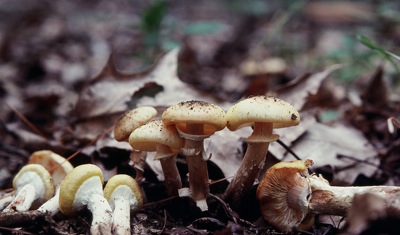
Armillaria mellea, The Honey Mushroom, yellow form
Read More…
Another piece of not-exactly amazing news: being physically warmed up – by holding a hot drink, for instance – makes people feel more warmly toward others, more generous, more tolerant, while getting chilled – by holding a coldpak, for instance – has the opposite effect. You can read all about it here or here.
And then you can be sorry all over again that “global warming” has gotten established as the shorthand for catastrophic climate change. Warm is a hugely positive word, as others before me have been pointing out for some time. If you’re trying to sound the alarm about human-caused atmospheric changes that have enormous downsides (flood, drought, and biblically destructive storms, for starters), using a word that’s more or less synonymous with “good” is probably not such a great idea.
Same problem with undifferentiated “climate change,” given that – as you may have heard lately – change can be something desirable.
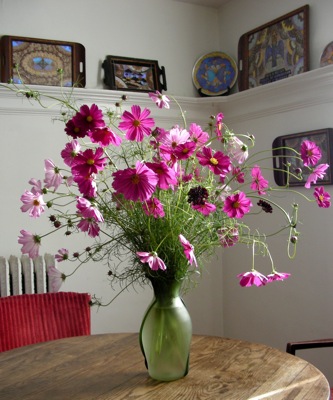
frost didn't hit the cosmos until mid-October, two weeks later than usual
Do I have a solution? Not for for the main problem, and not (at least so far) for what to call it. But for the keep yourself feeling warm part, can’t beat
Cream of (wild) Mushroom Soup
Rich in flavor but comparatively light in texture, a redemption of the genre. Also – if you tweak it a bit – a redemption of any recipe that has canned cream of mushroom soup on the ingredient list.
Read More…
Much as I love Blewits, one of the greatest wild mushrooms of any season, I’ve never gotten around to doing more than throwing in a mention when talking about fall bulb planting. This omission is now remedied. Our resident wild mushroom expert explains all in
BLEWITS AND THE LEAF-FALL
by Bill Bakaitis
In the Northeast autumn leaves start to fall shortly after the equinox. This colorful event takes over a month and a half to complete, during which time the fungi of the forest floor will become increasingly difficult to see. If you are after fall mushrooms you will want to get out now, before they are completely hidden by this new leaf fall.
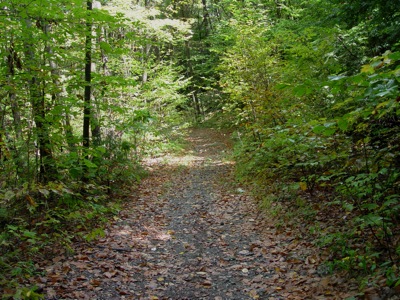
Early autumn on the mushroom trail
In a good year, like this one, autumn will begin with a tropical storm. The organic matter from the previous fall which has lain crisp and dry under the summer’s heat will revive becoming soft, moist and fragrant. In the days after the storm the air will hang hush and humid, languid with the last hot breath of summer.
Read More…

Cut in quarters and slice to serve
Here as promised in Bill’s how to find wild porcini post, is the recipe for Wild Mushroom and Caramelized Onion “Focaccia. ” The quotes are because I’m pretty sure real-deal focaccia is always plain bread with topping and this has many chunks of wild mushroom mixed into the dough. It can also have sundried tomatoes and olives, if you don’t like – or don’t have – mushrooms. Instructions for both after the jump.
Read More…