Garden
For everyone who can get to the mid-Hudson Valley this Saturday, May 16th.

Unusual ornamentals at Trade Secrets
Start out in Sharon, CT at Trade Secrets, purchasing ( or pining for) garden antiques, modern embellishments and rare plants brought by dealers and nurserypersons from all over New England.
Then head over to Millbrook, NY for Food for Thought, Plant a Row/Grow a Row, a celebration of local and home grown that offers everything from vegetable seedlings and master gardeners’ advice on growing them to chef’s demos, a wine and cheese tasting and book signings by Nava Atlas, Lee Reich – and me.
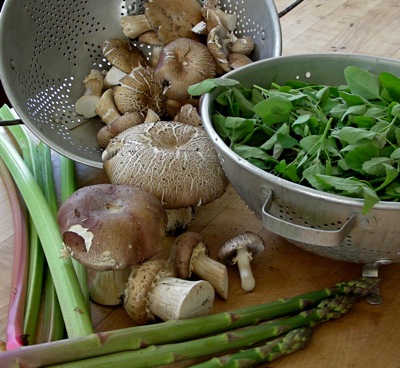
Clockwise from top: wine cap mushrooms (Stropharia rugosa annulata), Lambs Quarters, Asparagus, Rhubarb
Some of what’s growing in my garden – and could be growing in yours – right now
Read More…
Distantly, is my advice – not very originally; just about every experienced gardener, professional and otherwise, is of the same opinion. Knowing doesn’t hurt, but it doesn’t help much either, as I have just been reminded.
Twenty years ago, when falling in love with Bill meant moving 400 miles Southwest from my beloved Midcoast Maine to the then-unknown Hudson Valley, I had a standard grumble: “ Didn’t even get a climate zone out of it.”
They’re both 5b or maybe 6, depending on how you look at the up to date zone map, but here are the garden plants that were blooming in New York when I left for Maine on April 30th. :
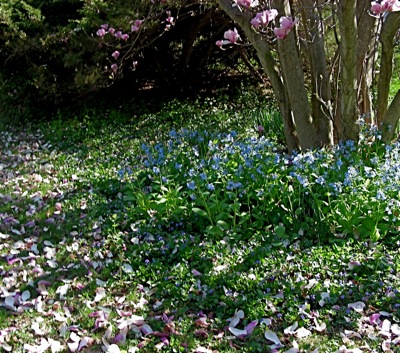
Virginia bluebells (Mertensia virginica) under the Magnolia x soulangiana already dropping its fat pink petals
Also, hellebores
Hyacinths
Narcissi
Tulips
Forsythia
Muscarii
Euphorbia
Forget-me-nots
Creeping phlox
Fragrant viburnums
Bleeding hearts
Spiraea
Apple
Plum
Fritillaria imperialis (barely)
And here’s what was blooming in Maine when I arrived:
Zilch.
Well not quite.

Hyacinth in the nepeta carpet
Read More…
I have a number of garden tools to which I am mightily attached, but none so precious as the Italian rototiller, my husband Bill, who has written this guest post about his favorite tool.
The Italian Rototiller
By Bill Bakaitis
It may not be what T. S. Elliot meant when he referred to April as being the cruelest month, but around here the breaking of spring ground also means breaking the sweet silence of winter. Motorcycles roar, dogs bark, the machinery of lawn maintenance springs into gear and out come the rototillers, churning and burning their way into the modern landscape. The ‘greening of exurbia’ is what they say. Consumer doublespeak is more like it.

The Grape Hoe, Mattock or Italian Rototiller, all oiled up and ready to go!
When I break ground I use Grandfather’s tool. Anglo types who hang out at the Agway probably call it a Mattock, and it is often listed in specialty garden supply outlets as an Italian Grape Hoe. I once heard it referred to disparagingly as an “Italian Rototiller” and in honor of my Calabrese Grandfather, that’s what I call it. Were he alive today he would chuckle and cherish the approbation. Leslie, of course, says it only works when used by an Italian (meaning me).
Why do I use and love it? Let me count the ways: Read More…
and pollen images like this

"seed of the Paulownia tree"
are just a microscopic part of The Kew Millenium Seed Bank Project, a major player in the worldwide effort to save endangered plant species.
The picture here was airily downloaded from a slide show of 18 gorgeous images published by The Guardian; and the news that it was up there came from Andrew Sullivan’s Daily Dish.
Or, Pruning spring-blooming shrubs that grow as thickets of svelte trunks and slender stems, because although they have their differences they all behave pretty much the same way.
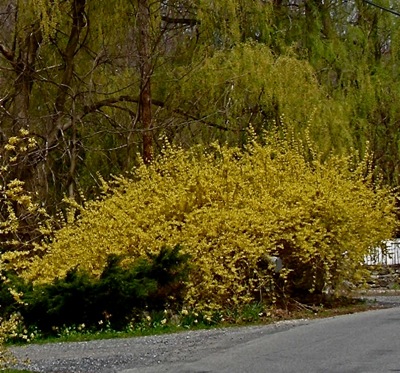
Forsythia in thicket mode
Flower buds form during the summer, mostly on one and two year old wood, so the standard advice is “prune right after bloom.” That way there’s maximum time for next year’s show to get itself together.
But after years of following that advice I started doing something that’s more fun and just as good or better from the pruning standpoint: making big bouquets. Read More…
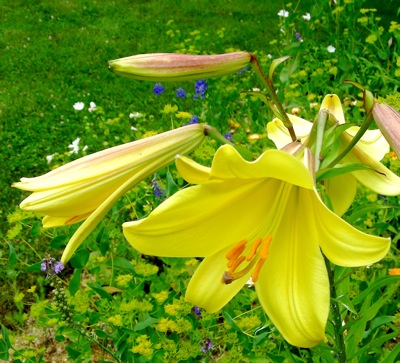
Lilium 'Golden Splendor'
Because the garden is always a relief from the cares of this world.
Because you can’t beat trumpet lilies.
And because neither suspect pistachios nor plagiarized DNA is exactly a visual thrill (whoopie pies are probably a matter of opinion).
Background: The day is warm and so is the soil. I decide to push it and plant some peas, even though the forsythia is only swollen instead of blooming and

Crocus are still the main attraction.
I look in the seedbox
It's in back. I couldn’t bear to edit him out
Gee, I thought I bought some.
Read More…

Start on the endless spring to-do list. Lawn and garden cleanup, shrub pruning, seed-starting, seed planting…
and (among yet other things)
* Consider the freezer
* Start on the bulb maps
* Figure out where the garlic is going to go
* Cut back and repot tired houseplants
* Scout for morel spots Read More…
“ Why won’t my amaryllis re-bloom?”
If only I had the proverbial dime for each time a reader wrote to me – at the New York Times, at Yankee, at (oh distant past) McCall’s – asking that question, I’d be rich. And if there were also dimes for “ why didn’t my daffodils flower?” Bill Gates would have to look to his laurels.
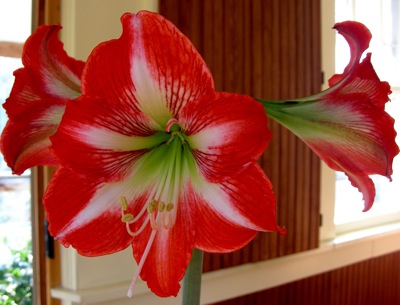
Amaryllis reblooming; this one is about 5 years old.
Answers were and are mostly about getting enough sun on the leaves that feed the bulb. Flowers for next year are already formed when these bulbs go dormant, so the stronger they are at that stage, the better the flowers will be. Good drainage is also essential, especially while the bulbs are leafless. And they prefer near-neutral soil, though they can make do in most cases.
Wet or very acid soil, shade, leaf-braiding and cutting leaves before their work is done are the most likely suspects when amaryllis or daffodils won’t flower. But there’s also another culprit that gets a lot less attention: the narcissus bulb fly, Merodon equestris.
Read More…
That’s “trellis” as in “utilitarian structure that holds up annual vines and comes down at the end of the season,” and the way we build them is with simple uprights and really a lot of untreated twine.

pole beans on sapling trellis, woods left and straight ahead
In Maine, we use saplings from the surrounding woods – they’re handy, they’re free, and because they’re nothing more than little trees they tie the riotous, colorful garden to its wild environment.
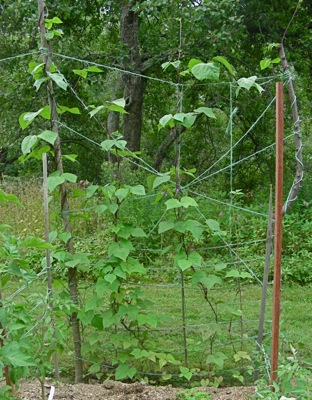
string and sapling trellis (please ignore oak posts in foreground)
This bean trellis was created by Kristi, who had evidently gotten bored with just running vertical lines. Beans would rather go up but will travel horizontally if encouraged. The spiderweb was completely covered about 2 weeks from this picture.
In New York, where there’s no convenient sapling source and the garden is if not formal at least orderly, we use 8 foot oak 2×2’s. Read More…